
The 7:1 Nesting Ratio: How Reusable Sleeve Packs Cut Return Freight Costs by 75%

Updated: May 4
The 7:1 Nesting Ratio: How Reusable Sleeve Packs Cut Return Freight Costs by 75%
When California manufacturers and 3PLs first hear about reusable sleeve packs, they typically focus on the per-unit cost versus cardboard. That's a fair comparison — and reusable sleeves win it clearly. But the calculation that often closes the deal isn't the purchase price. It's the return freight savings. And that story starts with the 7:1 nesting ratio.
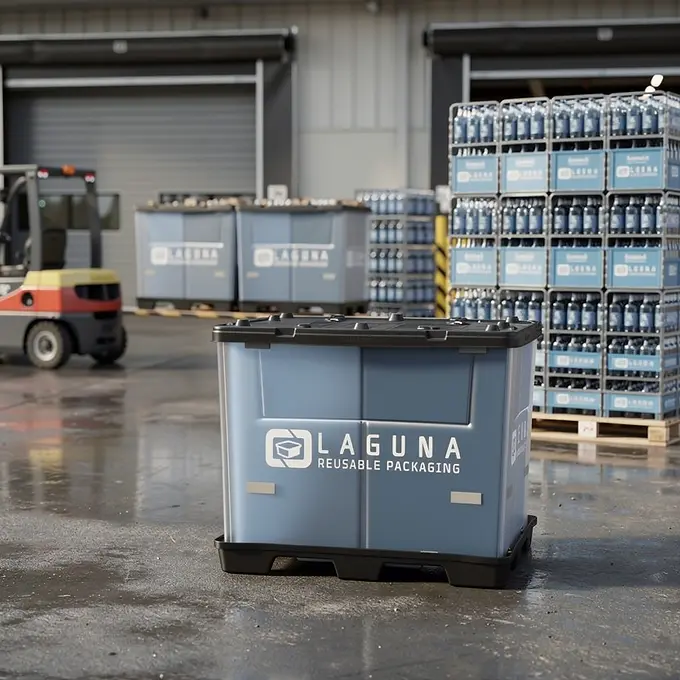
LagunaRP supplies reusable corrugated plastic sleeve packs from Santa Ana, California. Our sleeve packs feature a 7:1 nesting ratio when collapsed — meaning seven empty sleeves stack in the space of one full sleeve. This single feature transforms the economics of closed-loop bulk packaging.
What Is the 7:1 Nesting Ratio?
A corrugated plastic sleeve pack consists of four panels that fold flat when the sleeve is empty. When seven collapsed sleeves are stacked together, they occupy the same space as one fully assembled sleeve. This is the 7:1 nesting ratio.
In practical terms: if your operation ships 70 sleeves outbound per week, you can return all 70 empty sleeves in a single trailer using approximately 10 pallet positions — the same space 10 full sleeves would occupy. Without the nesting ratio, returning 70 sleeves would require 70 pallet positions — essentially a full dedicated truck.
The Return Freight Math
For a mid-size California distribution operation cycling 100 sleeve packs per week: without nesting, returning 100 sleeves costs $800 to $1,200 per return shipment at standard LTL rates. With the 7:1 nesting ratio, those 100 sleeves collapse to 15 pallet positions, reducing return freight to $150 to $250. Annual savings on return freight alone: $33,000 to $50,000.
For full product specifications including dimensions and assembly instructions, visit our product page.
3PL and Distribution Center Applications
3PLs and distribution centers benefit most from the 7:1 nesting ratio because their return freight volume is highest. A 3PL managing 50 lanes cycling 20 sleeves per week handles 1,000 sleeve returns weekly. The difference — 1,000 pallet positions versus 145 — represents $130,000 to $208,000 in annual freight savings.
Automotive Tier 1 and Tier 2 Applications
California automotive Tier 1 and Tier 2 suppliers use closed-loop sleeve pack systems to ship components to assembly plants. The nesting ratio determines the efficiency of the return lane between assembly plant and parts supplier — critical for keeping supply loop costs under control.
Food and Beverage Applications
Food and beverage manufacturers shipping bulk ingredients use the 7:1 nesting ratio to dramatically reduce empty container return costs — especially valuable for operations in California's Central Valley shipping lane.
Getting Started
Call us at (949) 990-8036 and we'll walk through the return freight math for your specific operation — volume, frequency, lane length, and current freight costs. Most California customers find their LagunaRP fleet pays for itself in return freight savings within 90 days.
Request a quote at lagunarp.com/contact. Minimum 5 units. No enterprise contract. Pricing from $68 to $89 per unit.
Content Production
Product photography and video production for LagunaRP by Advantage Video Production — video production company serving Orange County and Newport Beach, CA.


Comments